
Key Takeaways
- Watch what your kid does, not what the app promises a genuine top children English language iOS download gets opened without a fight, most days.
- Look past tapping games and check whether the app asks kids to actually speak out loud, with real-time feedback on pronunciation.
- Confirm the app runs fine for a pre-reader no reading required, just audio and pictures a 2 to 8 year old can follow alone.
- Check for a KidSafe listing and an ad-free setup before downloading anything; these two things matter more than flashy icons in the App Store.
- Test the free trial like a skeptic a fair one needs no credit card upfront and gives a real week to judge if the learning sticks.
- Come back in three weeks and see if it’s still teaching new words and games, or if your child’s already seen everything twice.
Type top children english language iOS download into the App Store search bar and you’ll get back a wall of nearly identical icons, bright colors, cartoon mascots, and a five-star badge slapped on every single one. Good luck telling the winners from the duds just by scrolling.
After years spent testing these apps with actual toddlers early readers (not focus groups, real kids on a real couch), the pattern becomes obvious pretty fast. Most apps get abandoned by day four. A few get requested by name every single afternoon. That gap isn’t random; it comes down to a handful of specific traits that separate a genuinely useful English-learning tool from a glorified digital sticker book.
Parents searching for a top children’s English language iOS download aren’t just hunting for something that keeps a 4-year-old quiet for ten minutes. They want proof the app actually teaches vocabulary that sticks, pronunciation a child will attempt out loud, progress they can see without interrogating a 6-year-old at dinner. The good news? You don’t need a teaching degree to spot the difference. You just need to know what to look for before you tap that download button.
Here are seven signs worth checking for starting with the one every parent notices first, whether they’re looking for it or not.
Sign 1: Your Kid Asks to Open It Without Being Told
Picture this: dinner’s done, homework (if any) is finished, and instead of grabbing the tablet for a cartoon, your four-year-old runs to find the learning app on her own. No nagging. No bribery with dessert. That’s the moment you know you’ve stumbled onto a top children english language ios download worth keeping.
Why Engagement Beats Screen-Time Guilt
Parents worry about screen time rightly so.
But guilt fades when the content actually teaches something. If a child chooses vocabulary games over a passive video, that’s active learning, not mindless tapping.
What Real Play-Based Learning Looks Like on a Small Screen
Look for short, game-like activities matching, tapping, singing that reward attention without flashing ads or confusing menus. A well-built app feels less like a lesson and more like a favorite toy. That’s the real test: does the icon on the home screen get tapped by choice, day after day?
Sign 2: It Teaches Speaking, Not Just Tapping
Most apps are glorified matching games.
Tap the picture, hear the word, move on that’s recognition, not language. A real top children’s English language iOS download gets your kid saying words out loud, not just poking at a screen.
The Difference Between Recognition Games and Real Pronunciation Practice
Recognition games test listening. Speaking practice tests production can your child actually form the sound? That gap matters more than most parents realize. A child who taps “apple” correctly for six months might still mispronounce it badly. Look for games that prompt speech, not just selection.
What On-Device Voice Feedback Should (and Shouldn’t) Do
Good voice feedback runs entirely on the device, gives real-time cues at the sound level, and works without the internet. It shouldn’t require typing, reading, or navigating menus by voice command. And it definitely shouldn’t upload or store your child’s voice anywhere. If a listing mentions cloud processing or vague “AI-powered” speech tools, ask exactly what that means before downloading.
Sign 3: There’s No Reading Required to Get Started
Can your four-year-old actually open the app and start playing without you hovering over their shoulder? That’s the real test. A genuinely good children’s English language iOS download leans on pictures, sound, and simple taps not blocks of instructional text a 5-year-old can’t decode yet.
Audio and Visual Cues That Work for Pre-Readers Ages 2-8
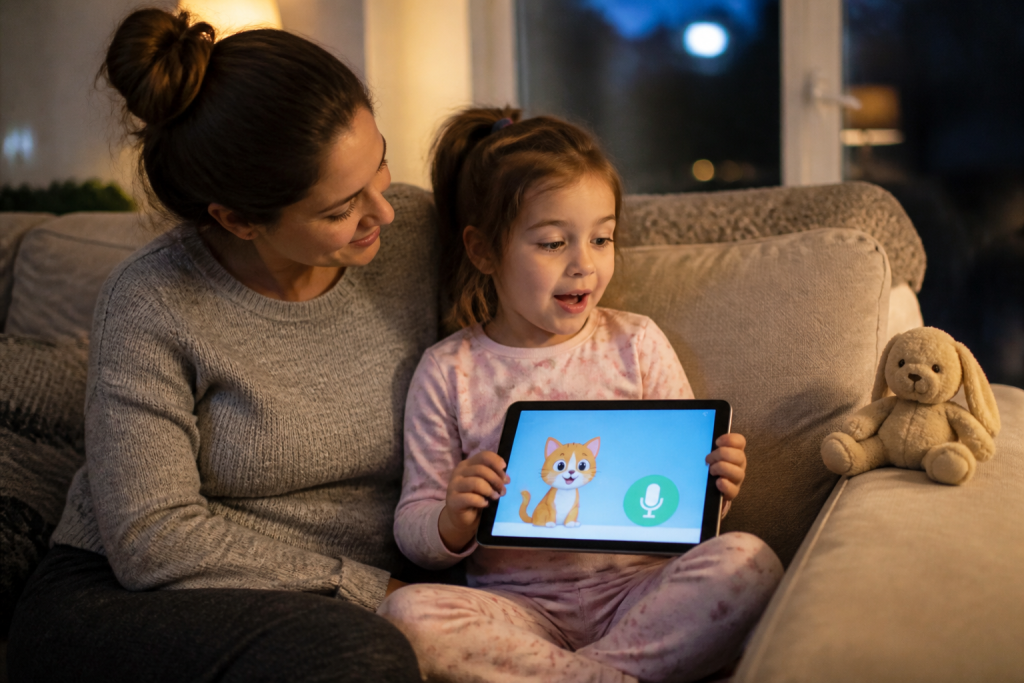
Look for apps built around icon-based menus, spoken prompts, and animated characters that model what to do. A cat mascot pointing at a picture works better than a paragraph of directions ever will.
In practice, the best apps for this age group use:
- Voice-guided instructions instead of written text
- Color-coded icons for navigation between games
- Repetition through songs and stories to reinforce vocabulary
If your child needs you to read every screen, it’s not built for pre-readers full stop.
Sign 4: It’s Actually Safe for a Young Child to Use Alone
Roughly 40% of kids’ apps in app stores still carry hidden ad trackers, according to child privacy watchdogs, a number that should stop any parent scrolling through a store listing before hitting download. If a child under 8 is going to sit alone with an iPad, the app better be built for that reality, not just marketed toward it.
Ad-Free Environments and Why They Matter More Than Parents Think
Pop-up ads don’t just interrupt learning, they train kids to tap blindly, which defeats the whole point of a focused lesson. A genuinely ad-free app removes that risk entirely. No mystery buttons, no accidental purchases, no jarring video ads mid-game.
Checking for a KidSafe Listing Before You Download
Before downloading, check the app’s privacy details for a KidSafe listing. It’s a quick signal not a guarantee, but a strong one that the developer has been reviewed against children’s privacy standards. Pair that with an ad-free design, and you’ve got an app a young learner can actually use unsupervised.
Sign 5: You Can See Progress Without Guessing
Here’s a myth worth busting: more badges don’t mean more learning. Plenty of apps flash animated stickers that mean nothing to a parent trying to figure out if vocabulary is actually sticking. A genuinely good children’s English language iOS download gives you real signal, not just noise.
Learner Reports That Actually Mean Something
Look for reports that break down specific skill areas: pronunciation attempts, vocabulary recall, listening comprehension rather than a vague completion percentage. A weekly summary that says “12 new words this week, 80% recall on review” tells you something. A spinning trophy icon doesn’t.
Handling Multiple Kids on One Household Subscription
If you’ve got two or three kids sharing a tablet, this matters even more. Separate learner profiles up to four on most solid apps keep progress untangled so one child’s streak of games doesn’t bury another’s report. Without that separation, you’re just guessing whose vocabulary actually grew this month.
Sign 6: The Free Trial Doesn’t Feel Like a Trap
Picture this: a parent downloads a top children’s English language ios download on a Sunday night, sets up a profile for a 4-year-old, and by Tuesday gets a payment reminder before anyone’s even finished three lessons. That’s a trap, not a trial. A good trial gives a full week (7 days is standard), no credit card required upfront, and lets the app store handle cancellation with one tap.
What a Fair Trial Period Looks Like on the App Store
Look for apps that let kids explore real games, not a locked demo screen. A fair trial shows actual lessons, actual voice practice, actual progress tracking. If the free version feels gutted just to force an upgrade, that’s a red flag worth noting to yourself (not out loud, the kid’s watching).
Reading the Fine Print on Annual Versus Monthly Plans
Annual plans usually save money over paying monthly, but check what happens at renewal. Does it auto-renew silently? Can you cancel anytime through Apple’s subscription settings? Read that before tapping subscribe.
Sign 7: It Still Feels Fresh After Week Three
Most kids’ apps run dry by day 21.
That’s just the truth. Any decent top children english language iOS download needs enough games, songs, stories, and printables to survive a toddler’s attention span which, let’s be honest, resets constantly.
Content Depth: Games, Songs, Stories, and Printables
Look for a library with well over a thousand game variations, not a dozen recycled quizzes. Songs and short stories should rotate naturally between activities, not sit in a separate, forgotten tab. Printable worksheets matter too (they give kids something physical to do after screen time ends).
Signs an App Is Running Out of Material Fast
Watch for these red flags:
- The same three mini-games repeat within a single week
- New vocabulary stops appearing after the first module
- Your child starts skipping ahead out of boredom
- There’s no printable or offline option at all
If those show up early, the app won’t hold attention past a month no matter how polished the icon looks in the store.
What to Ignore in App Store Search Results
Ever typed “kids English learning app” into the App Store and gotten a wall of nonsense back? That’s normal and most of it isn’t worth a second glance.
Filtering Out Irrelevant Apps and Unrelated Search Noise
Search algorithms are messy. You’ll see gaming apps, video editing tools, even random utilities mixed into results meant for a top children English language iOS download. Skip anything built for teens or adults, flashcard grinders, exam-prep tools, anything with ads front and center. If the icon looks like a shooting game rather than a friendly cartoon, move on.
Reading Ratings and Reviews Without Getting Fooled
Star ratings lie more than parents realize. A 4.8 with only 40 reviews means nothing if you want thousands of reviews, ideally 10,000-plus, with recent dates. Read the one- and two-star reviews first; that’s where real problems show up. Look for specific complaints: crashes, forced subscriptions, confusing menus. Vague five-star praise (“great app!”) tells you nothing useful.
How This Fits Into Your Child’s Weekly Learning Routine
Fifteen minutes. That’s roughly what early-childhood researchers point to as the sweet spot for a young child’s focused attention span on a screen-based task and it’s exactly why the best options for a top children’s English language ios download build sessions around that window instead of longer ones.
Building a Simple 15-Minute Practice Habit
Here’s what works in practice: three short sessions a week beat one long weekend cram, every time. Pick a fixed slot after breakfast, before bath time and let the app’s built-in games and songs carry the pacing. Kids don’t need a laptop, a desktop, or even a tablet plugged into some fancy setup; an iPhone or iPad and a quiet corner is plenty.
- Monday/Wednesday/Friday: 15-minute vocabulary games
- One weekend day: a story or song for reinforcement
- Weekly check of the progress report to spot gaps
Consistency beats intensity. A predictable rhythm, not marathon sessions, is what actually builds retention.
Final Checklist Before You Hit Download
Here’s a myth worth busting: more games doesn’t mean better learning. Parents assume a bigger library of activities signals quality, 1,000 shallow taps teach less than 50 well-built ones that cycle vocabulary back into new contexts. Before tapping install on any top children english language ios download, run through this list instead.
- Does it work without reading? Young kids need audio-guided navigation, not text menus.
- Is it ad-free? No pop-ups interrupting a four-year-old mid-lesson.
- Can more than one child use it? Separate profiles matter in multi-kid households.
- Is there real speaking practice, not just tapping pictures?
- Can you see progress through some kind of report or badge system?
- Is there a free trial before any payment is required?
- Is safety certification listed KidSafe, specifically?
Check all seven, and you’ve found something worth keeping.
Miss three or more? Keep scrolling the App Store.
Frequently Asked Questions
What is the best free English speaking app for kids?
Look for one that has kids actually talking out loud, not just tapping pictures. A handful of children’s English apps on the App Store now include real-time speaking games with pronunciation feedback, and a 7-day free trial is common, so you can test the speaking features before paying anything.
What is the best child app for iPhone?
There’s no single answer here, it depends on the child’s age and what you’re trying to fix. For a 3 to 8 year old learning English specifically, prioritize apps built for that age band over general-purpose kids’ apps, since the games, pacing, and audio guidance are designed around short attention spans.
Is an AI-based English app better than a standard game-based app?
Not necessarily. A lot of parents assume AI features automatically mean better learning, but for young kids, structured game-based repetition with real speaking practice usually beats a chat-style AI tool. Young children need predictable, playful reps, not open-ended conversation.
What is the best English learning app for iPhone?
The best one is whichever app your child will actually open on their own and stick with for more than a week. Check for ad-free design, a kidSAFE listing, independent play with no reading required, and a free trial with no credit card, then let your child’s engagement be the real test.
How much screen time should a young child spend on an English learning app?
Realistically, 15 to 20 minutes a day is plenty for a 2 to 8 year old. Short, focused sessions with games, songs, stories beat long marathon sessions every time kids retain more from five short bursts a week than one long one.
Do these apps work offline?
Many children’s English apps, including speaking-based games, can run core content offline once downloaded. Voice recognition features in particular often process everything directly on the device rather than sending audio anywhere, which matters for both privacy and spotty wifi.
Can more than one child use the same iPhone download?
Yes, and this matters more than parents expect. Look for apps that support multiple learner profiles under one account so each child’s progress, badges, and level stay separate instead of getting mixed up on a shared device.
How do I know if my child is actually learning, not just playing?
Progress reports are the honest answer here. A good app will show you vocabulary learned, topics completed, and listening or speaking activity over a week not just a screen time total. If an app can’t show you that, you’re flying blind.
What age should a child start using an English learning app on an iPhone?
Most children’s English apps are built for ages 2 to 8, though the sweet spot for independent use (no reading required) is usually 3 and up. Content appropriate for ages 3+ tends to rely on audio, pictures, and simple game mechanics rather than text.
None of these seven signs require a computer science degree to spot. A kid who reaches for the tablet on her own, a lesson that asks him to say the word instead of just tap it, a report that actually tells you what your child learned this week are the real markers of quality, not star ratings or slick screenshots. Every parent’s search for a top children’s English language iOS download eventually comes down to the same question: does this hold up after the novelty wears off? Week three is the real test. Not day one.
So here’s the move. Before downloading anything else, pull up the app you’re already considering and run it through this list: engagement, speaking practice, safety, visible progress, a fair trial, and content that doesn’t run dry. If it fails two or more, keep looking. If it passes, give it a real seven-day trial with your child sitting right next to you, watching how she reacts in the first ten minutes. That reaction will tell you more than any review ever could.