
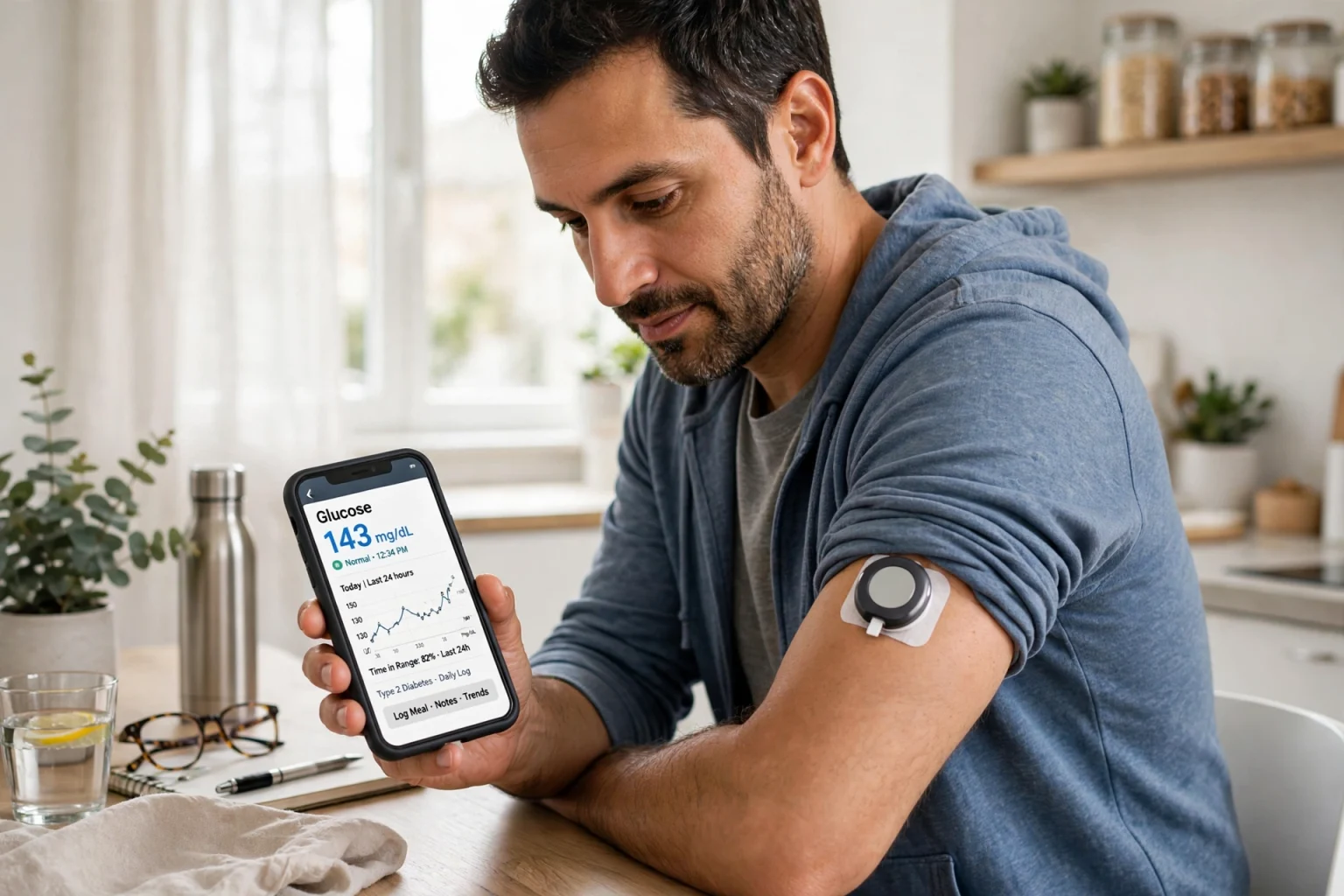

Continuous glucose monitors can substantially improve day-to-day blood sugar control for adults with type 2 diabetes who do not use insulin, according to the largest clinical trial of its kind, published in the New England Journal of Medicine. Participants using the wearable sensors spent approximately five more hours a day in their target blood sugar range, a change researchers describe as both measurable and meaningful for long-term health.
The finding matters because continuous glucose monitors, often called CGMs, have traditionally been associated mainly with people who use insulin. This trial asked a broader and increasingly important question: can real-time glucose information help the much larger group of people with type 2 diabetes who manage their condition with lifestyle measures and non-insulin medicines?
What the Trial Found
Researchers reported that adults given access to continuous monitoring spent about five additional hours each day in range, compared with their starting point. In diabetes care, time in range has become a central measure because it captures the pattern of a whole day, not just a single average. A person can have an acceptable average while still swinging repeatedly between highs and lows; more time in range suggests steadier, safer control.
Details released by the University of Colorado Anschutz Medical Campus summarised the headline result, and the scale of the trial gives the conclusion unusual weight. Rather than a short pilot in a highly selected group, this was a large test designed to reflect the patients clinicians see every week.
How Continuous Glucose Monitors Work
A CGM uses a small sensor, typically worn on the arm or abdomen, to measure glucose in the fluid beneath the skin throughout the day and night. Readings are sent to a phone or receiver, where users can see current values, direction arrows and patterns after meals, exercise, sleep and medication.
That feedback loop is the heart of the benefit. A finger-prick test tells you where your glucose is at one moment. A monitor shows what happened after breakfast, how a walk changed an afternoon reading, or whether levels rose overnight. Over days and weeks, those patterns can guide small, sustainable adjustments to food choices, activity and the timing of medicines, in discussion with a care team. The American Diabetes Association provides general education on monitoring and time-in-range goals for people living with diabetes.
Why Five More Hours Matters
Five hours a day compounds quickly. Across a week, it represents roughly thirty-five more hours in a healthier range; across a year, it is the equivalent of more than seventy-five full days. Persistent high blood sugar is linked over time with damage to blood vessels, nerves, kidneys and eyes, so any intervention that reliably shifts daily patterns, without adding a complex drug regimen, deserves attention.
Just as importantly, the information can reduce uncertainty. Many participants in studies of this kind say that seeing the direct effect of a meal is more motivating than general advice alone. Our earlier explainer on how Ozempic can affect appetite and eating habits explored a related theme: treatments work best when people can connect a therapy with the daily choices around it.
Who Could Benefit, and What Are the Limits?
The trial focused on adults with type 2 diabetes who do not use insulin, a group that has historically had less access to monitoring technology, partly because of cost and coverage rules. Clinicians will now be weighing which patients are most likely to benefit: those whose control is above target, those making active lifestyle changes, and those whose medicines carry a risk of low blood sugar may be strong candidates.
There are limits to consider. Sensors require regular replacement, can cause skin irritation for some users, and generate a large amount of data that not everyone finds helpful. Cost and insurance coverage remain real barriers, and a monitor is not a substitute for medical follow-up. Readers interested in how newer diabetes medicines act in the body can also see our guide to how Mounjaro works in the body, which sets this technology in the context of a rapidly changing treatment landscape.
What Patients Should Ask Their Clinician
Anyone considering a monitor should discuss three questions. First, what target range is appropriate for me, given my age, other conditions and medicines? Second, how will we use the data at follow-up appointments, rather than simply collecting it? Third, what will the sensor and supplies cost over a full year, including any coverage conditions?
It is also wise to agree in advance how to respond to alarms and out-of-range readings, so that information leads to calm action rather than anxiety. Diabetes care works best as a partnership, and technology is most useful when it supports that partnership instead of replacing it.
A Shift in Everyday Diabetes Care
The broader significance of this trial is cultural as much as technological. Diabetes management is moving away from occasional snapshots toward continuous, personalised feedback, much as fitness and heart health have done. If access expands in line with the evidence, monitors could become a routine tool for many more people with type 2 diabetes, not only for those on insulin.
For now, the message is encouraging and clear. In the largest test of its kind, giving people continuous information about their own blood sugar helped them spend about five more hours a day in a healthy range. That is time, quite literally, that better health is made of.