
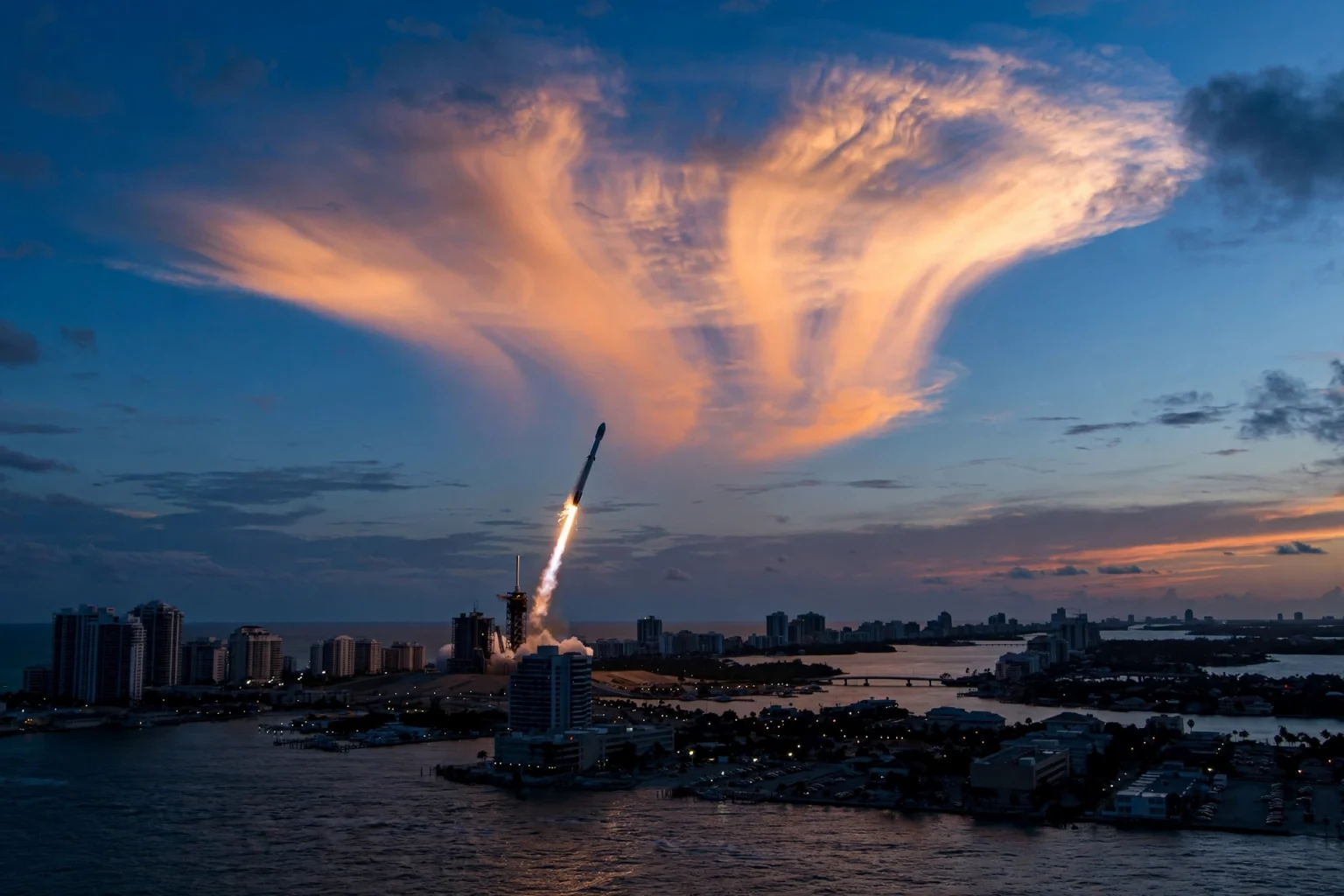

A routine evening rocket launch turned into an unforgettable sky show this week, when a SpaceX launch off the United States east coast produced a glowing, tentacled formation that witnesses quickly compared to a giant jellyfish drifting through the twilight. Photographs and videos shared from coastal communities showed a bright core expanding into soft, translucent trails, lit long after the ground below had slipped into darkness.
The spectacle, widely reported after the launch, is a reminder that some of the most striking sights in modern spaceflight happen not on the launch pad, but high in the atmosphere in the minutes that follow liftoff. For residents who happened to be looking up at exactly the right moment, it was a brief and beautiful collision of engineering, sunlight and altitude.
What Creates a Jellyfish Cloud After a Launch?
The so-called jellyfish effect usually appears during launches near dawn or dusk. The rocket climbs into a part of the sky that is still touched by sunlight, even though observers on the ground are already in shadow. Exhaust from the rocket expands in the thin upper atmosphere, where there is far less air pressure to contain it, and that expanding plume catches the low sunlight.
The result is a luminous bloom with trailing strands, rather than the tight white contrail people expect behind an aircraft. As the plume spreads, it can glow blue, white, pink or gold depending on the angle of the sun and the composition of the exhaust. Coverage of this week’s display by The Guardian described a stunning cloud visible off the east coast, and the images explain why the nickname has stuck: the formation really does seem to pulse and drift like a sea creature in a dark ocean.
Why Twilight Launches Look So Different
Timing is everything. A midday launch is impressive mainly for its noise, flame and speed. A twilight launch adds a natural light show. The rocket passes through layers of atmosphere that are experiencing different times of day at once, and the contrast between a darkening landscape and a sunlit plume makes the effect visible across a surprisingly wide area.
Weather helps, too. Clear skies, low humidity near the surface and an unobstructed view toward the coast gave skywatchers in several states a clean line of sight. Many people first assumed they were seeing an unusual cloud, a comet or even something harder to explain, before launch schedules confirmed the source. Agencies such as NASA have long noted that high-altitude plumes and noctilucent-style displays can be visible hundreds of miles from a launch site.
Public Fascination With an Expanding Launch Cadence
Scenes like this are becoming familiar as launch activity increases along the Florida coast and at other United States spaceports. More frequent missions mean more chances for the public to witness upper-atmosphere effects that were once seen only by a relatively small community of dedicated launch watchers. Each striking display sends a fresh wave of people outside with phones in hand for the next evening departure.
That public attention matters for the wider space economy as well. Commercial launches now carry communications satellites, research payloads and crew, and they draw the same rolling public and investor interest that surrounds other major infrastructure stories. Our recent coverage of how central banks turned cautious as markets watched fresh inflation data showed how closely households follow big economic signals; launch nights, in their own way, have become a shared national signal of technological momentum.
How to Watch the Next One
If you want to catch a jellyfish cloud yourself, start by checking launch schedules and choosing a night or early-morning window close to sunrise or sunset. Find a location with a clear view toward the launch site, ideally away from bright street lighting, and allow your eyes a few minutes to adjust. The display, if it forms, usually appears a few minutes after liftoff, once the vehicle has reached high altitude, and it may last only a short while before the plume disperses.
Photographers recommend a phone or camera capable of longer exposures, a steady surface or tripod, and patience. Just as important is managing expectations: not every twilight launch produces the effect, because sun angle, altitude, winds and exhaust conditions must line up. When they do, however, the payoff is remarkable.
Within minutes, posts asking what the strange light could be were answered by amateur astronomers who recognised the pattern immediately. As our guide to keeping transaction records organized also shows, a little preparation makes a confusing moment much easier to understand.
A Brief Show With a Lasting Impression
By the time the plume faded, the rocket itself was long gone, its mission continuing far beyond what any observer could see unaided. What remained were photographs, conversations and a renewed sense of wonder at how visible modern spaceflight has become to ordinary people standing in gardens, car parks and beaches.
As launch schedules remain busy through the rest of the year, east coast residents may not have to wait long for another chance. Keep an eye on the twilight sky after the next departure. Sometimes the most memorable part of a mission is not the fire at liftoff, but the quiet, glowing jellyfish that blooms in its wake.